Taliban 2.0: Fall Of Afghanistan And What If Means For India
TALIBAN 2.0: FALL OF AFGHANISTAN AND WHAT IT MEANS FOR INDIA offers a rigorous, narrative-driven exploration of Afghanistan’s turbulent history and its pressing present. Written for readers of international affairs, policy enthusiasts, students, and curious minds, this book presents a clear lens on how centuries of power struggles shape today’s realities. The tone is measured, insightful, and urgently relevant, inviting readers to consider the region’s future with clarity and care.
Dr. Joseph Thomas uses a historical lens to trace empires—from the Mughals to the Americans—and the cycles of rise and fall that have defined Afghanistan. TALIBAN 2.0 builds a cohesive narrative around the original Taliban regime, the emergence of Taliban 2.0, and the security and economic implications their resurgence brings. The book contrasts Afghanistan’s internal dynamics with regional interests, showing how Pakistan, China, and other powers engage to advance their goals. Structured with clear chapters and a steady pace, the book offers a readable, insightful look at a long-running story that remains central to global security.
It presents key concepts in a straightforward way, weaving historical context with contemporary implications, and uses case-study-style explanations of interventions—U.S. policy, and the broader lessons from Vietnam, Iraq, and Syria—without assuming prior expertise. The writing in TALIBAN 2.0 is measured and engaging, guiding readers through Afghanistan’s geopolitics and the stakes for India with clarity and nuance.
- Comprehensive historical and contemporary analysis of Afghanistan and the Taliban
- In-depth look at Taliban 1.0 and Taliban 2.0 and their security and economic implications
- Examination of regional dynamics involving Pakistan, China, and India, and how they shape events
- Lessons from past interventions (U.S., Vietnam, Iraq, Syria) and their relevance today
- Clear, accessible writing with structured chapters, timelines, and case studies
- Policy-focused insights and practical implications for regional stability
After reading TALIBAN 2.0, readers gain a nuanced understanding of Afghanistan’s ongoing challenges and the regional stakes, especially for India. The book leaves you better informed, more thoughtful, and prepared to engage in discussions about geopolitics and policy, offering a grounded perspective on how South Asia might navigate a complex post-conflict landscape.
Product Information
Product Information
Shipping & Returns
Shipping & Returns


Taliban 2.0: Fall Of Afghanistan And What If Means For India
Taliban 2.0: Fall Of Afghanistan And What If Means For India
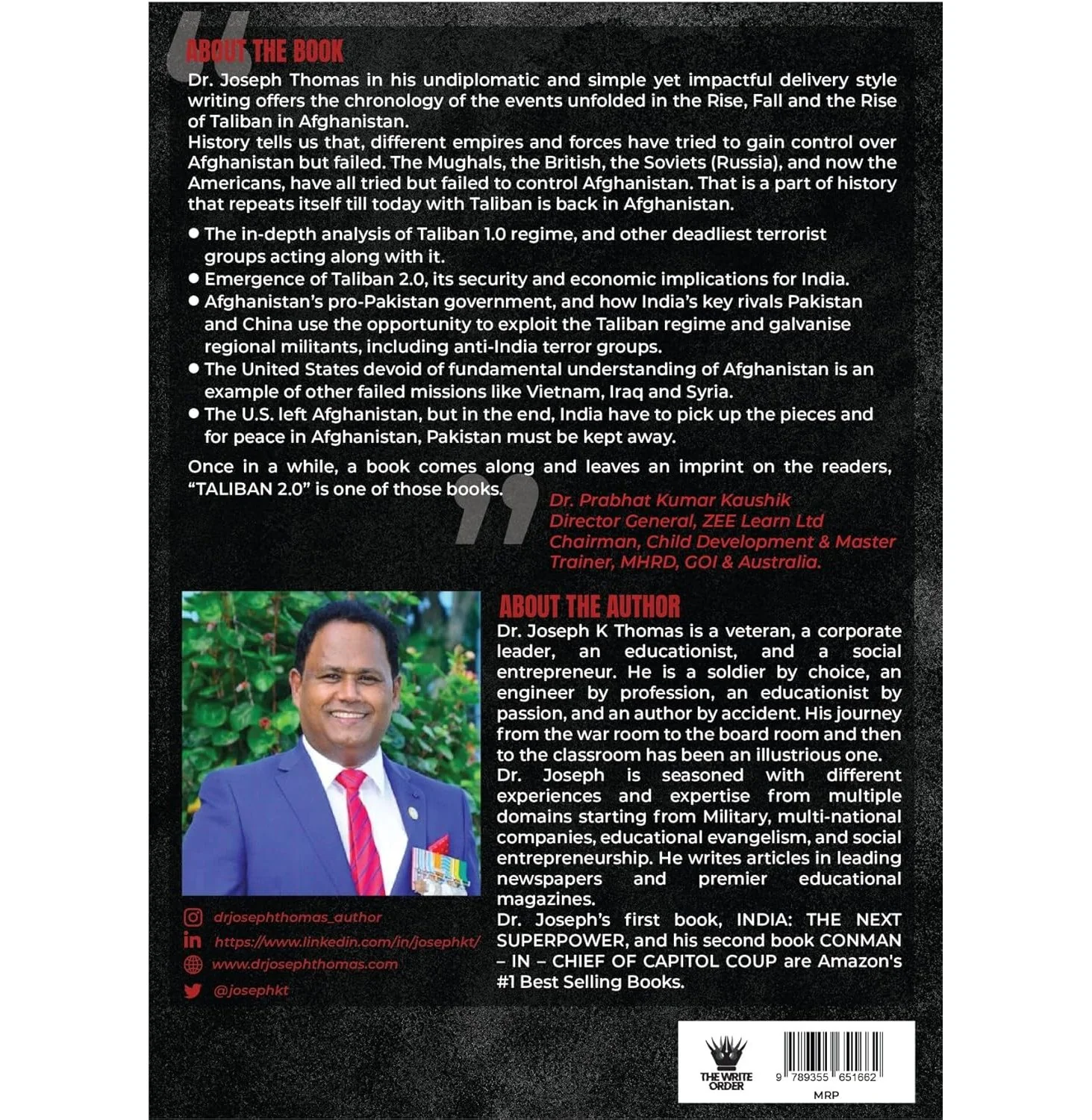
TALIBAN 2.0: FALL OF AFGHANISTAN AND WHAT IT MEANS FOR INDIA offers a rigorous, narrative-driven exploration of Afghanistan’s turbulent history and its pressing present. Written for readers of international affairs, policy enthusiasts, students, and curious minds, this book presents a clear lens on how centuries of power struggles shape today’s realities. The tone is measured, insightful, and urgently relevant, inviting readers to consider the region’s future with clarity and care.
Dr. Joseph Thomas uses a historical lens to trace empires—from the Mughals to the Americans—and the cycles of rise and fall that have defined Afghanistan. TALIBAN 2.0 builds a cohesive narrative around the original Taliban regime, the emergence of Taliban 2.0, and the security and economic implications their resurgence brings. The book contrasts Afghanistan’s internal dynamics with regional interests, showing how Pakistan, China, and other powers engage to advance their goals. Structured with clear chapters and a steady pace, the book offers a readable, insightful look at a long-running story that remains central to global security.
It presents key concepts in a straightforward way, weaving historical context with contemporary implications, and uses case-study-style explanations of interventions—U.S. policy, and the broader lessons from Vietnam, Iraq, and Syria—without assuming prior expertise. The writing in TALIBAN 2.0 is measured and engaging, guiding readers through Afghanistan’s geopolitics and the stakes for India with clarity and nuance.
- Comprehensive historical and contemporary analysis of Afghanistan and the Taliban
- In-depth look at Taliban 1.0 and Taliban 2.0 and their security and economic implications
- Examination of regional dynamics involving Pakistan, China, and India, and how they shape events
- Lessons from past interventions (U.S., Vietnam, Iraq, Syria) and their relevance today
- Clear, accessible writing with structured chapters, timelines, and case studies
- Policy-focused insights and practical implications for regional stability
After reading TALIBAN 2.0, readers gain a nuanced understanding of Afghanistan’s ongoing challenges and the regional stakes, especially for India. The book leaves you better informed, more thoughtful, and prepared to engage in discussions about geopolitics and policy, offering a grounded perspective on how South Asia might navigate a complex post-conflict landscape.
Original: $3.64
-70%$3.64
$1.09Product Information
Product Information
Shipping & Returns
Shipping & Returns
Description
TALIBAN 2.0: FALL OF AFGHANISTAN AND WHAT IT MEANS FOR INDIA offers a rigorous, narrative-driven exploration of Afghanistan’s turbulent history and its pressing present. Written for readers of international affairs, policy enthusiasts, students, and curious minds, this book presents a clear lens on how centuries of power struggles shape today’s realities. The tone is measured, insightful, and urgently relevant, inviting readers to consider the region’s future with clarity and care.
Dr. Joseph Thomas uses a historical lens to trace empires—from the Mughals to the Americans—and the cycles of rise and fall that have defined Afghanistan. TALIBAN 2.0 builds a cohesive narrative around the original Taliban regime, the emergence of Taliban 2.0, and the security and economic implications their resurgence brings. The book contrasts Afghanistan’s internal dynamics with regional interests, showing how Pakistan, China, and other powers engage to advance their goals. Structured with clear chapters and a steady pace, the book offers a readable, insightful look at a long-running story that remains central to global security.
It presents key concepts in a straightforward way, weaving historical context with contemporary implications, and uses case-study-style explanations of interventions—U.S. policy, and the broader lessons from Vietnam, Iraq, and Syria—without assuming prior expertise. The writing in TALIBAN 2.0 is measured and engaging, guiding readers through Afghanistan’s geopolitics and the stakes for India with clarity and nuance.
- Comprehensive historical and contemporary analysis of Afghanistan and the Taliban
- In-depth look at Taliban 1.0 and Taliban 2.0 and their security and economic implications
- Examination of regional dynamics involving Pakistan, China, and India, and how they shape events
- Lessons from past interventions (U.S., Vietnam, Iraq, Syria) and their relevance today
- Clear, accessible writing with structured chapters, timelines, and case studies
- Policy-focused insights and practical implications for regional stability
After reading TALIBAN 2.0, readers gain a nuanced understanding of Afghanistan’s ongoing challenges and the regional stakes, especially for India. The book leaves you better informed, more thoughtful, and prepared to engage in discussions about geopolitics and policy, offering a grounded perspective on how South Asia might navigate a complex post-conflict landscape.